Maria Hapsari L. // 22.03.52.0010
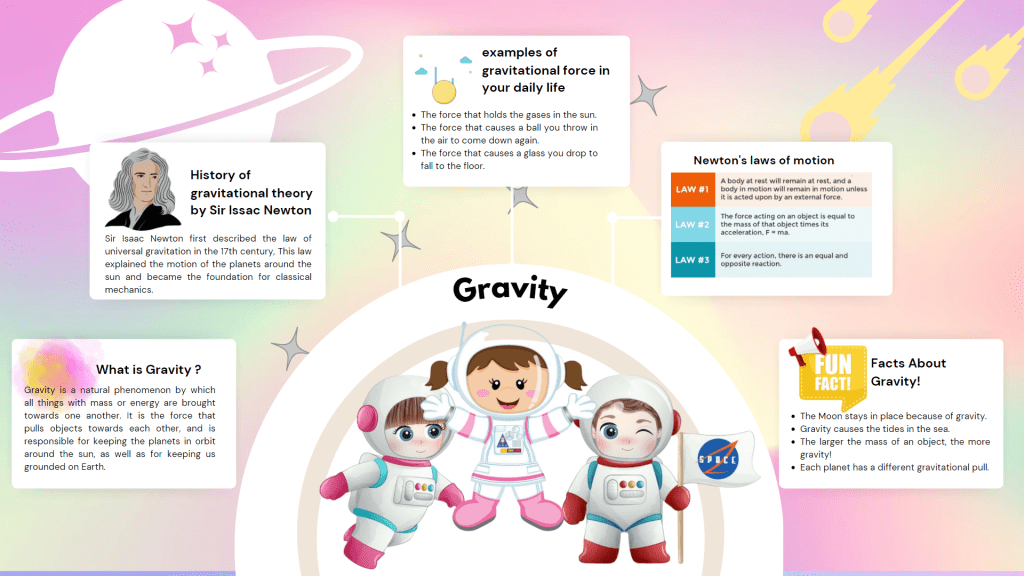
What is gravity?
Gravity is a natural phenomenon by which all things with mass or energy are brought towards one another. It is the force that pulls objects towards each other, and is responsible for keeping the planets in orbit around the sun, as well as for keeping us grounded on Earth.
Gravity is one of the fundamental forces of nature, along with electromagnetism, the strong nuclear force, and the weak nuclear force. It was first described by Sir Isaac Newton in his law of universal gravitation, and later refined by Albert Einstein’s theory of general relativity.
History of gravitational theory
- Sir Isaac Newton first described the law of universal gravitation in the 17th century, which stated that every object in the universe attracts every other object with a force that is directly proportional to their masses and inversely proportional to the distance between them. This law explained the motion of the planets around the sun and became the foundation for classical mechanics.
- Albert Einstein’s, In the early 20th century Albert Einstein’s theory of general relativity proposed a new understanding of gravity as a curvature of spacetime caused by the presence of matter and energy. This theory explained the observed bending of light around massive objects, such as stars, and predicted the existence of black holes.
Today, gravity continues to be studied and researched by scientists to better understand its fundamental nature and how it interacts with other fundamental forces in the universe.
Examples of gravitational force in your daily life
1. The force that holds the gases in the sun.
2. The force that causes a ball you throw in the air to come down again.
3. The force that causes a car to coast downhill even when you aren’t stepping on the gas.
4. The force that causes a glass you drop to fall to the floor.
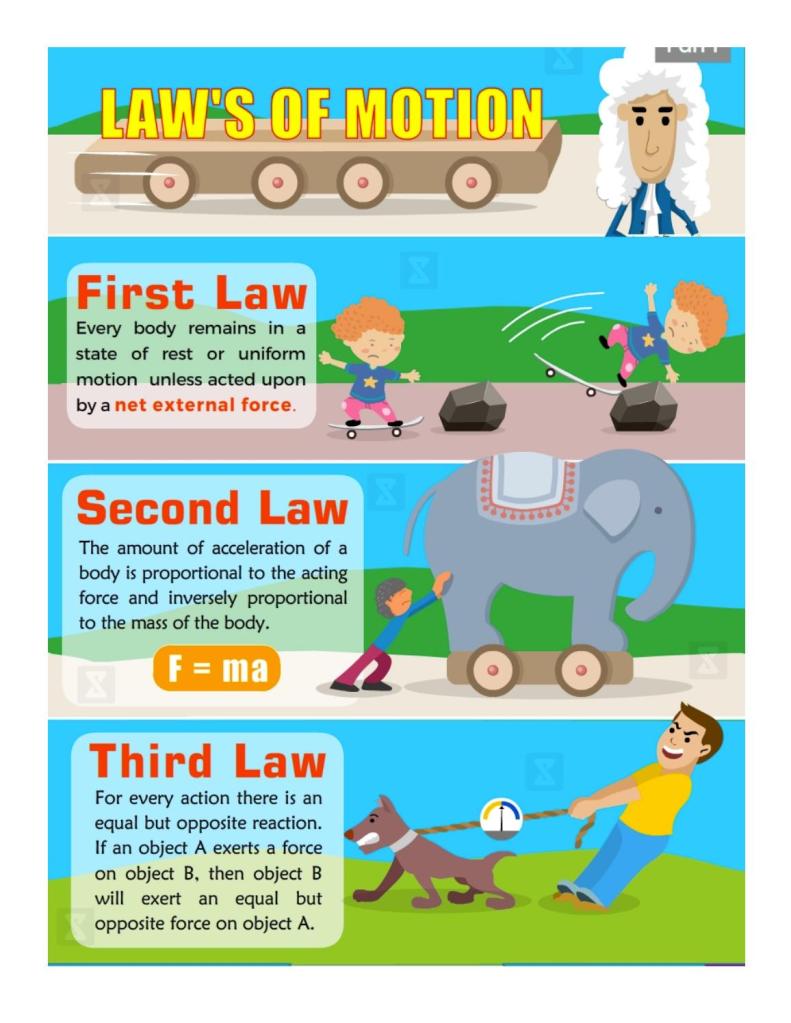
Newton’s Laws of motion
Fun Fact about Gravity
- The Moon stays in place because of gravity.
If gravity didn’t exist then the Moon would have probably floated away by now! It is kept in place by the gravitational force from Earth. Luckily the moon is travelling at the perfect speed. - Gravity causes the tides in the sea.
Did you know that gravity causes the tides in our seas and oceans? This is because gravity makes everything in the universe pull on each other. The Moon pulls on Earth and in turn, makes the water move! As Earth rotates, the water in our seas and oceans will build up on the side closest to the Moon. This is why we have high and low tides. - The larger the mass of an object, the more gravity! Mass is different to weight. Mass is made up from how many atoms are in the object. Weight is different because if you weighed yourself on Earth and then weighed yourself in space, it would be completely different! The mass of an object never changes. The larger the mass of an object, the more gravity there will be on that object.
- Each planet has a different gravitational pull.
Gravity varies on each planet. This is because each planet has a different gravitational pull as each planet has a different mass. An object that weights 100 pounds on Earth, would weigh 38 pounds on Mercury!
 Judul Situs